
Meet the Instructor: Palermo & the Evolution of the City
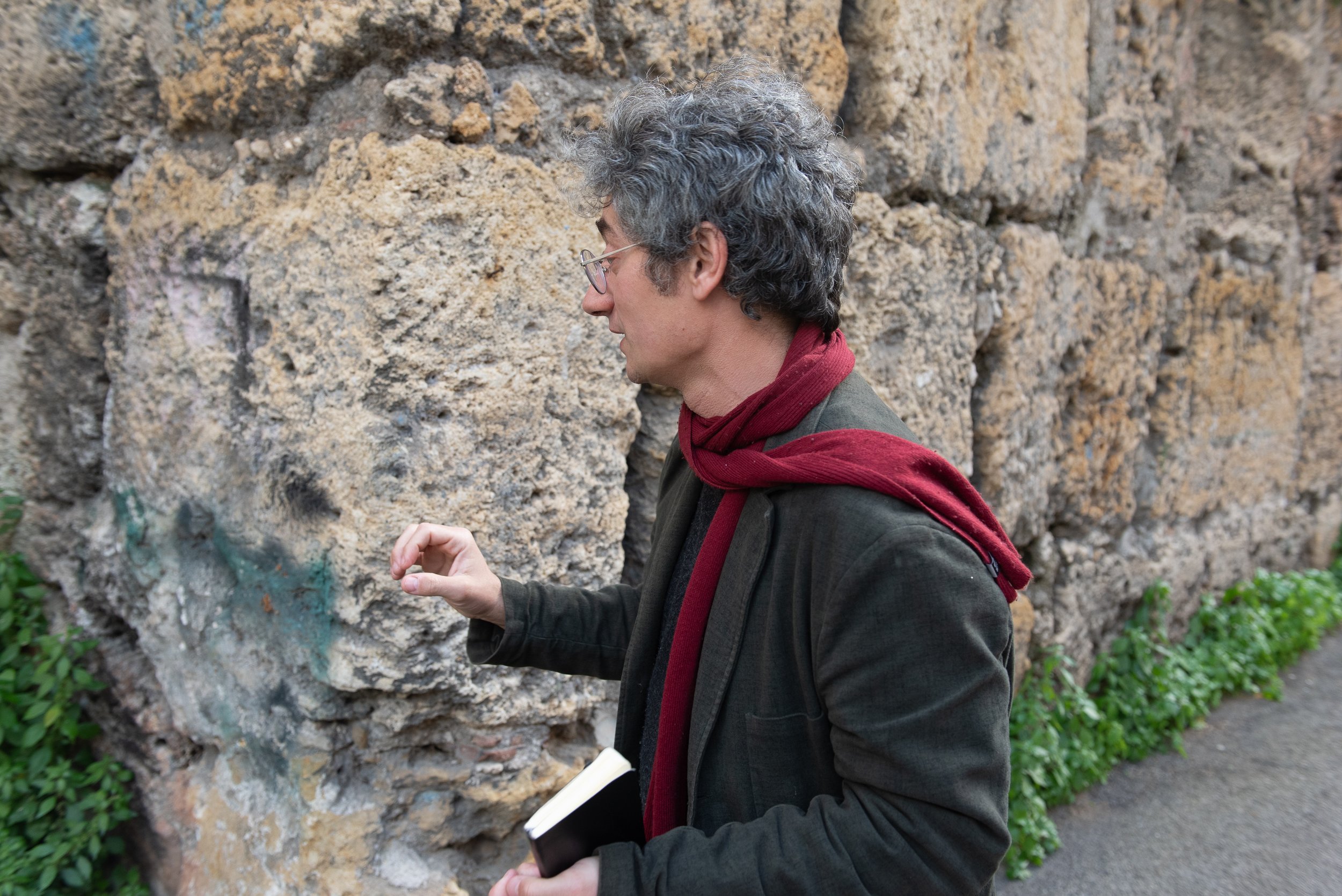
Giuseppe Ferrarella is a Palermo-born architectural historian who has spent his career studying how cities evolve, tracing the physical and cultural layers that accumulate over centuries into the urban fabric we walk through today. He reflects here on why Palermo is not what it appears to be, what its long history of overlapping civilizations reveals about cities more broadly, and why walking through a city is itself a form of learning.
Q: How did Palermo first become central to your work?
A: I was born in Palermo, but I grew up outside the city. When I returned for university, Palermo was still relatively unknown beyond Sicily—or burdened by a negative international reputation. Over time, I began to discover a very different city: one revealed through its narrow streets, churches, overlooked spaces, and unexpected overlaps.
Palermo became truly central to my work during my PhD in Rome, when I was invited to study the city academically, but from a distance. That distance proved essential. It was a place I knew intimately, yet observing it more objectively allowed deeper structures and long-term processes to come into focus—insights that not only clarify Palermo, but offer ways of understanding cities more broadly.
One example comes from my research on Palermo’s main axis, Via Vittorio Emanuele—a street students will walk along many times during the course. While studying its present form, I identified traces of the much older Cassaro, the city’s original foundational route. What surprised me was that this ancient street is still visible today not only in the urban layout, but within the internal organization of historic buildings and in a series of courtyards that were once part of the street itself and later enclosed. It’s a clear illustration of how very old urban structures continue to shape the city in subtle but obvious ways.
Q: What do most visitors misunderstand about Palermo when they first arrive?
A: Many visitors arrive expecting a city that is clear and easily readable. During his Grand Tour, Goethe described Palermo as an orderly place structured around a grand intersection of main streets, gently descending toward the sea. Beyond those streets, he observed more labyrinthine areas, but overall he experienced the city as compact and immediately comprehensible.
What is often misunderstood is that this clarity is only superficial. Earlier historical sources describe a very different Palermo: a city shaped by hills, valleys, ravines, waterways, ditches, and dramatic changes in elevation. None of this has disappeared. Instead, it has been absorbed and transformed within the urban fabric—often in ways that remained unrecognized until quite recently.
Palermo may appear simple, but it is the result of overlapping and sometimes competing ideas of what a city should be. Unlike cities that develop through clear vertical layering—one period built neatly atop another—Palermo evolves through interweaving. Streets, open spaces, and buildings intersect, deform, and adapt to one another, coexisting within the same space. It is this underlying complexity that often escapes first-time visitors.
I often think of Edgar Allan Poe’s The Purloined Letter, in which something remains invisible precisely because it is in plain sight. Palermo works in much the same way.
Q: The course is called Palermo and the Evolution of the City. In what ways is Palermo representative of “the city” more broadly? What makes it a useful lens for understanding how cities everywhere take shape and change over time?
A: It would be misleading to say that Palermo represents all cities of the world. Yet when we study cities through their long-term evolution and stratification, something interesting happens: they begin to resemble one another, even though no two are ever the same.
A useful comparison is certain forms of historical architecture, such as churches. Churches across the Western world differ greatly, yet they share underlying principles and structures that make them immediately recognizable. They are never identical, but they speak a common language.
The same is true of cities. When we study a city through its underlying patterns—its relationship to the terrain, to water, to the sacred—we begin to see principles that extend beyond a single place. Palermo becomes a kind of laboratory: by learning to read it carefully, we develop tools for interpreting many other cities, which then appear both profoundly distinct and unexpectedly similar.
Q: How do you expect this Elective will change the way students see and experience other cities?
A: Students will leave with vivid memories of Palermo and a clearer understanding of how it works—how to orient themselves within it, and how to tell its story if they return. But the most lasting effect goes beyond Palermo.
What remains is a new way of observing cities—and the world more broadly. Through Palermo, students begin to recognize recurring patterns: the relationship between urban form and terrain, between cities and natural resources, between settlement and defense, water systems, and the rituals and collective practices that shape shared space.
These patterns are not unique to Palermo, nor even to the Western world. They appear, in different forms, in cities everywhere. At that point, unexpected correspondences begin to emerge: a street in Palermo may recall something in Genoa, Paris, or even Rio de Janeiro—not because they are identical, but because they respond to similar urban logics.
In this sense, the course does more than teach how to read Palermo. It provides transferable tools that help students recognize underlying structures and relationships wherever they travel—a way of seeing that continues to work long after they leave Sicily.
Q: What do you most look forward to when spending a week exploring Palermo with a group of students?
A: What I most look forward to is the unexpected. Walking through Palermo always involves a degree of discovery — even when you set out with a clear objective, something unplanned inevitably emerges. A detail, a hidden courtyard, an overlooked alignment suddenly opens up a new story.
I love that sense of shared exploration: beginning with an idea, but allowing the city itself to guide us somewhere we didn’t anticipate. Those moments of surprise — when curiosity takes over and the city reveals something new — are what make the experience truly alive for me.
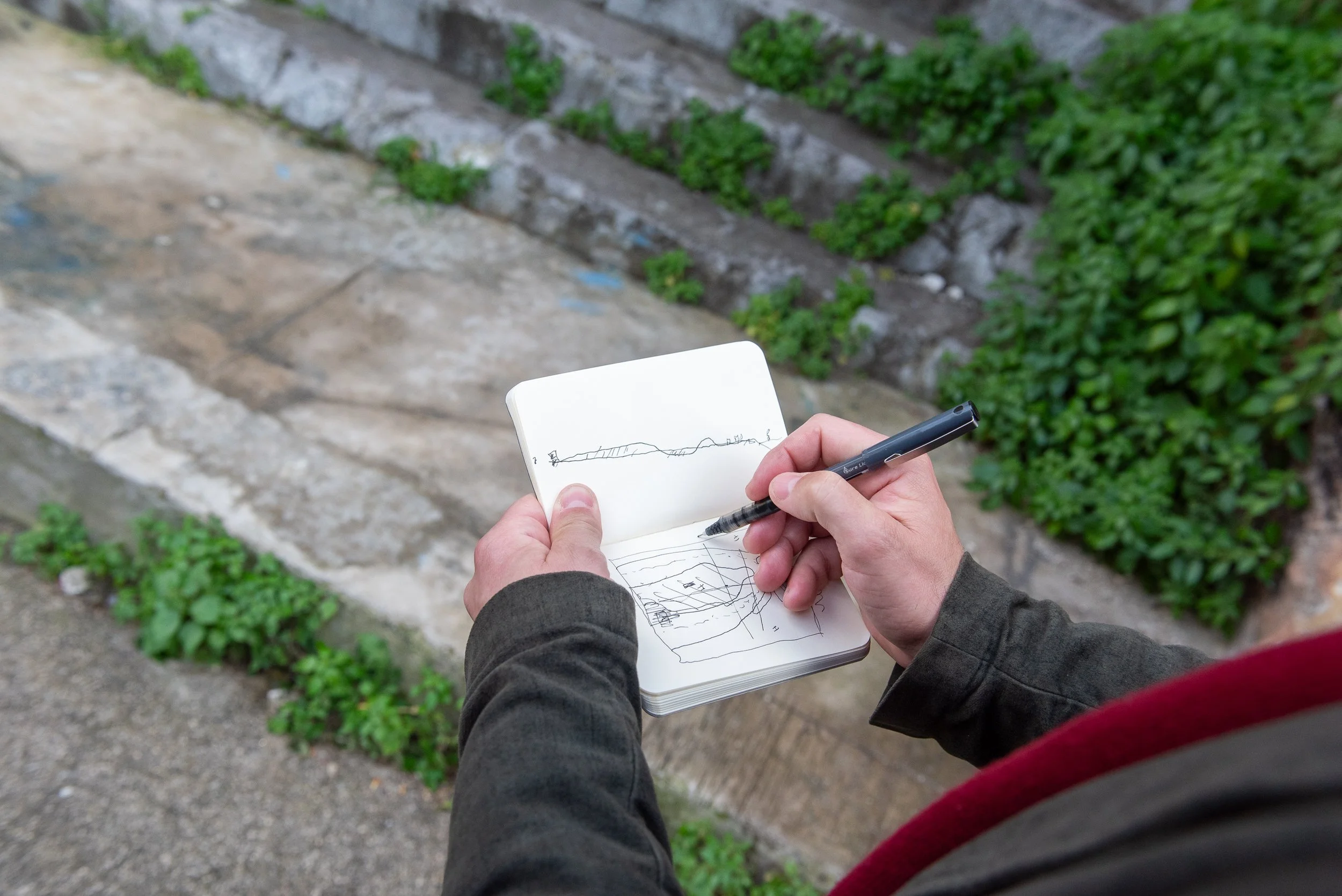
Giuseppe sketching a cross-section of Palermo — mapping how each era of the city was built upon the last.